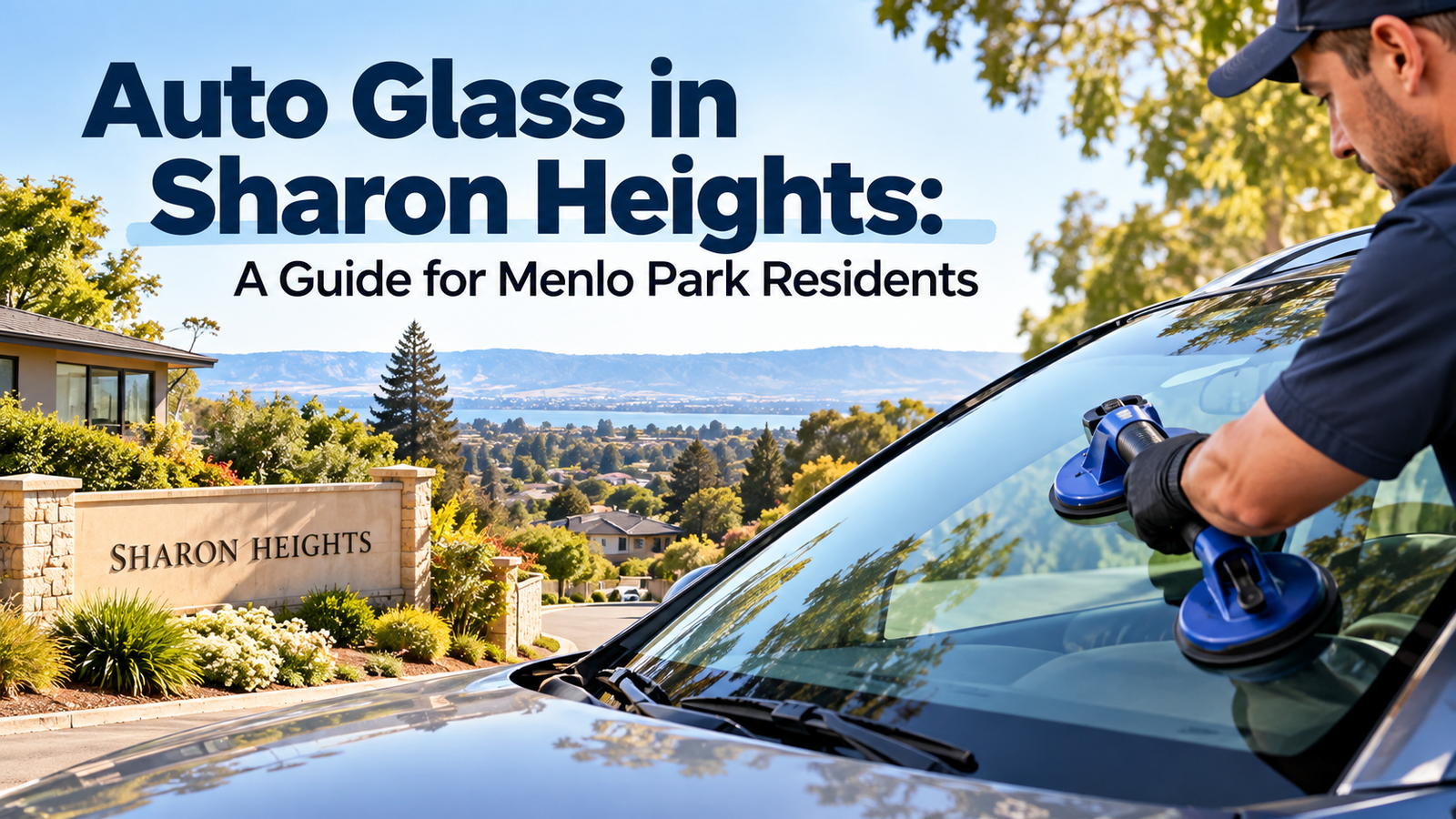
Sharon Heights is a neighborhood in the eastern hills of Menlo Park, known for the Sharon Heights Golf and Country Club and the residential streets that climb toward the Portola Valley border. Its position at the edge of the Santa Cruz Mountain foothills gives it a slightly different microclimate from the flatlands below more morning fog in summer, cooler temperatures, and greater canopy cover. Residents navigate a mix of Sand Hill Road, Interstate 280, and the El Camino corridor for their daily routes, and like the rest of the Peninsula, deal with the Auto Glass Shop Sharon Heights damage that comes with regular highway travel.
Sand Hill Road and Highway 280: Glass Damage Sources
Sand Hill Road is one of the most significant venture capital corridors in the world, but for Sharon Heights residents it’s primarily a commute artery connecting the neighborhood to I-280 and Palo Alto. The road’s surface through the hillside sections carries debris from adjacent landscaping, occasional rock fall from cut sections, and the residual gravel that settles at the road edge after storm events. At the Sand Hill-280 interchange, the transition from a low-speed curving road to a high-speed freeway means that debris kicked up by any vehicle becomes a windshield hazard.
Interstate 280 through San Mateo County is one of California’s most scenic freeways, but its northern segments through the foothills carry significant truck and construction vehicle traffic supplying the ongoing development in the South Bay and Peninsula. Trucks represent a disproportionate source of windshield chip damage because of their wheel size, the debris carried in their wheel wells, and the force with which they kick up road material at freeway speeds.
Sharon Heights’ tree canopy also means parked vehicles are exposed to falling acorns, seed pods, and small branches. In fall, when oak trees drop acorns, impact damage from falling acorns is a specific local hazard particularly for vehicles parked under mature oak canopy on residential streets.
Auto Glass Replacement Standards and Safety
The Federal Motor Vehicle Safety Standard (FMVSS) 205 governs the manufacturing quality of replacement auto glass. This standard specifies requirements for optical quality, impact resistance, and material properties. All replacement glass used by reputable shops must be certified to meet FMVSS 205, and California state law requires that auto glass replacement meet applicable federal safety standards.
The installation adhesive the urethane that bonds the windshield to the vehicle’s pinchweld is governed by FMVSS 212, which addresses windshield mounting in crash conditions. The adhesive must cure to sufficient strength to retain the windshield during the force of a frontal crash or airbag deployment. This is why drive-away times matter: leaving before the adhesive has reached rated strength risks a windshield that will not perform as a structural safety component in a crash.
The Auto Glass Safety Council (AGSC) administers the AGRSS (Auto Glass Replacement Safety Standards) program, which establishes quality and process standards for glass replacement shops. AGSC-registered shops commit to following defined installation procedures, using compliant materials, and providing training for technicians.
ADAS Systems on Common Peninsula Vehicles
The Sharon Heights and broader Menlo Park area has high concentrations of vehicles with advanced driver assistance systems (ADAS) not only Tesla and other EV brands but the full range of modern luxury and mainstream vehicles with safety technology features. Honda Sensing, Subaru EyeSight, Volvo City Safety, Mercedes Pre-Safe, and BMW Driving Assistant all use forward-facing cameras mounted in or near the windshield that require recalibration after glass replacement.
The recalibration requirement is not a matter of preference it is a safety necessity. A camera that is not recalibrated after glass replacement may register the road surface at a slightly incorrect angle, causing the lane departure system to trigger incorrectly, the automatic emergency braking to misidentify the stopping distance, or the adaptive cruise control to maintain incorrect following distances. These are not minor inconveniences; they are safety-critical errors in systems specifically designed to prevent accidents.
Static calibration requires positioning the vehicle in a controlled environment and using a manufacturer-specific target and diagnostic software. Dynamic calibration requires driving the vehicle at a specified speed on lane-marked roads while the system self-calibrates using road input. Some vehicles require both static and dynamic calibration steps. Auto glass shops that are properly equipped for this region’s vehicle mix should be able to confirm calibration requirements at the time of appointment scheduling.
Rear Window and Side Glass in Hillside Neighborhoods
Sharon Heights’ topography means that vehicles are often parked on grades. Parking on a grade creates slightly different stress conditions on glass than flat parking the vehicle’s weight distribution shifts, affecting how the body flexes and how that flex transmits to glass through the frame. For damaged side glass or rear glass, these additional stresses are secondary considerations, but they reinforce the importance of using quality materials that meet the vehicle’s specification.
Side glass replacement in the Sharon Heights area frequently involves privacy glass darkened glass that is standard on many luxury vehicles sold in the California market to manage solar heat gain. Matching the original privacy glass tint level in the replacement glass maintains both aesthetic consistency and the functional heat-rejection benefit. Aftermarket side glass is available in varying tint levels, and specifying the correct match requires knowing the original glass’s visible light transmittance.
Dealing with Insurance for Auto Glass in California
Peninsula residents with comprehensive auto insurance coverage have specific rights in California regarding glass claims. The California Department of Insurance regulates insurer conduct around glass claims, and the state’s consumer protection framework prohibits insurers from directing policyholders exclusively to specific shops or misrepresenting the policyholder’s right to choose their own repair provider.
When filing a glass claim, policyholders should have on hand: vehicle VIN (to confirm glass specification), a description of the damage, and any documentation of when and where the damage occurred. For chips that can be repaired rather than replaced, some insurers waive the deductible for chip repair recognizing that repair is less expensive than replacement and incentivizing prompt action that prevents a chip from becoming a full crack.
For vehicles with ADAS systems that require recalibration after windshield replacement, California law requires that insurers cover the cost of ADAS recalibration as part of the windshield replacement claim when recalibration is required by the vehicle manufacturer. This requirement was established through California Insurance Department guidance that recognizes recalibration as a necessary component of safe windshield replacement on equipped vehicles.
Frequently Asked Questions: Auto Glass in Sharon Heights
How long does a mobile windshield replacement take in Sharon Heights?
The physical replacement typically takes 60 to 90 minutes. Adhesive cure time adds another one to a few hours before the vehicle can be safely driven. For appointments with ADAS recalibration required, additional time should be planned static recalibration takes 30 to 60 minutes in a controlled environment, which may require driving the vehicle to a separate recalibration location after the glass replacement is complete.
What happens if I drive before the windshield adhesive has cured?
Driving before the adhesive has reached its minimum drive-away strength risks windshield retention failure in a crash. The windshield contributes to roof crush resistance and airbag deployment effectiveness a windshield that is not properly bonded may separate from the vehicle in a rollover or frontal collision, eliminating that structural contribution. The safe drive-away time specified by the adhesive manufacturer should always be observed.
Can rock chip repair be done through insurance without affecting my deductible?
Many California insurers offer chip repair without applying the deductible, treating it as a separate minor claim category or waiving the deductible specifically for chip repair. The specific terms depend on the policy. It is worth confirming chip repair coverage terms with the insurer before assuming the deductible applies in many cases, prompt chip repair is covered at no out-of-pocket cost to the policyholder.
Does the type of glass matter for a basic commuter vehicle without ADAS features?
For vehicles without camera-based ADAS systems, the primary quality considerations are optical clarity, proper fit, and adhesive quality. Aftermarket glass certified to FMVSS 205 is legally compliant and structurally adequate for these vehicles. The practical quality differences between certified aftermarket glass and OEM glass are less pronounced on vehicles without integrated sensor systems, though fit and finish quality can vary between aftermarket manufacturers.